Showing posts with label UK. Show all posts

Tuesday, January 25, 2011

Bulwark back at sea

3rd Street Promenade


NOW this is a sight to warm the cockles of British hearts in a cold, dark winter.
Dark being particularly pertinent here, for it was in the fading light of a late January afternoon that HMS Bulwark put to sea for the first time in nearly a year.
The assault ship has undergone an eight-month overhaul in the hands of Babcock in Devonport.
In those eight months, some £32m has been spent revamping the ship’s machinery spaces,  magazines, her high voltage propulsion system, advanced communication sensors, computer and IT network, and upgrades to her defensive weapons systems.
Another significant improvement has been Bulwark’s conversion to full tactical night vision for her landing craft and helicopters; the overhaul means that she will now be able to operate two Chinooks simultaneously from her flight deck.

Thursday, January 20, 2011

Work continues on the UK Queen Elizabeth-class aircraft carrier

Workers at BAE Systems in Portsmouth have begun work on the second major hull section of HMS Queen Elizabeth, the United Kingdom's new aircraft carrier. A steel cutting ceremony at the company’s facility this week marked the official start of production on the stern section, referred to as Lower Block 05. 

Weighing over 1000 tonnes on completion, this section will house switchboards, air treatment units and the vessel’s steering gear, as well as some accommodation areas. “This latest achievement in the Queen Elizabeth-class aircraft carrier programme follows the start of production on the forward section of the hull, Lower Block 02, which began in February of last year,” the company says in a publicity statement. 

HMS Queen Elizabeth and HMS Prince of Wales will displace about 65 600 tonnes at full load and will almost certainly be seen in South African waters in due course. The ships will measure 284 metres in length and will be capable of carrying up to 40 aircraft, including the Lockheed Martin F35 Lightning II. According to current planning, in terms of recent defence budget cuts, the Queen Elizabeth will only enter service in 2020 and the Prince of Wales is expected to be kept in a state of "extended readiness" after completion. 

Wednesday, January 19, 2011

Tods Bow Sonar Domes For Australian Air Warfare Destroyers

Tods Bow Sonar Domes For Australian Air Warfare Destroyers
Composite materials specialists Tods Defence have secured the order for three Bow Sonar Domes for the new fleet of Royal Australian Navy 'Air Warfare Destroyers' (Hobart Class) which are due to start coming into service from 2013/14.

The Class is a derivative of the Spanish F105 design and is being developed by the Air Warfare Alliance comprising the Defence Material Organisation, Australian Submarine Corporation (ASC) and Raytheon Australia. It will be built at a new facility adjacent to the ASC facilities in Adelaide.
The design and build Bow Sonar Dome contract for Tods Defence is part of a continuing partnership with the Australian naval industry, with each of the new units being produced in the UK to coincide with the ship build programme.
Bow Sonar Dome enclosures are specifically designed to house underwater warfare detection systems and sensors. Variants of Tods products are now installed numerous platforms worldwide including F100 and F310 frigates, on the RN Type 45 destroyers and US Navy DDG 1000 Zumwalt Class ships.
Steve Burton, Managing Director Tods Defence say: "Although our design concept has been in proven service with a number of navies for thirty years, with each new class of vessel we have to work closely with international systems providers in their development so that we can fine tune particular customer requirements to provide the optimum performance."

Monday, January 17, 2011

Pay your last respects to Ark Royal this weekend

THERE is a last chance to see Britain’s greatest modern warship – and her ship’s company – this weekend.
The sailors of HMS Ark Royal will march through the streets of Portsmouth on Saturday as the city bids farewell to the most high-profile victim of last autumn’s defence review.
As well as that parade the carrier will also be opening its gangway for the final time to members of the public allowing a last tour of the 20,000-ton veteran of the Adriatic and Gulf wars.
The ship made her final entry to Portsmouth on a bitterly cold December day – snow and ice meant that only a few hundred, rather than the anticipated few thousand, onlookers witnessed Ark sail into harbour trailing her decommissioning pennant.
Even before that last entry, however, civic leaders vowed to celebrate the carrier’s 25-year association with her home port, inviting the ship’s company to march through the centre of Portsmouth.
And so at 11.20am on Saturday around 250 men and women from Ark Royal will form up in Paradise Street (in front of the city centre Tesco supermarket) before following a Royal Marines Band down Commercial Road – Portsmouth’s principal shopping street – past the railway station and into Guildhall Square.

Link with wartime bomb disposal heroes broken


THE Navy has lost a key link with its greatest generation with the death of legendary wartime bomb disposal officer Noel Cashford.
Lt Cashford, who has died aged 88, rendered more than 200 unexploded bombs and other devices safe during WW2 and its immediate aftermath.
He always played down his bravery saying simply: “I had my moments”, but his selfless actions meant he was appointed an MBE at the war’s end.
Although he left the Service in 1947 he remained passionate about the wartime work of his comrades,  supporting efforts to erect monuments, attending memorial services, giving speeches and compiling four books on the exploits of WW2 bomb disposal men.
“Today’s generation should know about the heroes of yesteryear and those who do the same dangerous job today,” he declared at 70th anniversary commemorations of the first German magnetic mine being defused by his friend Lt Cdr John Ouvry.
Lt Cashford was believed to be the last surviving naval wartime bomb and mine disposal officer.
“Over the past ten years, I have come to rely on Noel as a living link with our wartime explosive ordnance disposal heritage and will dearly miss his friendship, knowledge and valuable advice,” said Lt Cdr Rob Hoole, vice chairman of the Minewarfare and Clearance Diving Officers Association.
Lt Cashford praises the work of wartime comrades aboard HMS Belfast in 2009. Picture: PO(Phot) Mez Merrill

Saturday, January 15, 2011

Britain wants to cooperate with India in Navy ship building


NEW DELHI (PTI): Britain Friday said it wanted to extend cooperation with India in the field of naval ship building.


"There is a considerable scope. There are common things like the way we build ships in the UK. The way we operate is common with the way India does. We do think that naval area is one where there are immense opportunities," British High Commissioner to India Richard Stagg told reporters here.

India and the UK have had a long Navy-to-Navy relationship as both the aircraft carriers which the Indian Navy has operated were earlier in service with the British Navy.

India, which has embarked on a major modernisation plan for its armed forces, has emerged as a favourite with various defence equipment-manufacturing countries with its plan of spending over USD 100 billion on defence in the next ten years.

Friday, January 14, 2011

Defending the carriers


With Britain's Queen Elizabeth class aircraft carriers not due to enter service for nearly a decade and talk of strong new threats to carriers emerging, Dr Lee Willett, Head of RUSI's Maritime Studies programme, examines their viability


The United Kingdom's two Queen Elizabeth class aircraft carriers survived the 2010 Strategic Defence and Security Review (SDSR) – but only just. Despite the demonstrable strategic value of two highly flexible flat-topped ships in meeting a range of UK tasks from the high end to the low end of the spectrum, the carriers' fate hung in the balance right until the very end of the review. Even today, their fate may still not be secure. Despite carriers' demonstrated utility in Kosovo, Sierra Leone, Iraq, Afghanistan, the Asian tsunami, Hurricane Katrina, the Lebanon, Haiti and the ash cloud, questions continue to be asked about their strategic value. 

These questions generally can be grouped under two broad assumptions. The first is that they are expensive, inflexible Cold War relics. Yet £5bn to build two ships which can show the strategic flexibility to adapt to a range of circumstances and conflicts over up to 50 years of life demonstrates extremely good value for money. For example, the US Navy carrier USS Enterprise (CVN-65) is 49 years old, has more deployments due, and has seen active service during the Cuban Missile Crisis, Vietnam and Afghanistan – each a different crisis requiring a different response.

Wednesday, January 12, 2011

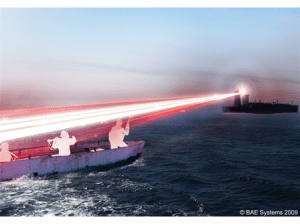
BAE Systems develops non-lethal laser to defend against pirate attacks on commercial shipping

Bristol, UK, — BAE Systems has successfully demonstrated a prototype device that will serve as an effective non-lethal deterrent against pirate attacks on commercial vessels such as oil tankers and container ships.
Piracy worldwide is on the rise according to reports from the ICC’s International Maritime Bureau (IMB), with 430 attacks worldwide reported last year, up from 406 in 2009. As pirates increase their range of operations and their capabilities, commercial shipping agents are increasingly looking for ways of preventing attacks whilst avoiding armed guards on their ships.
In order to help combat the growing piracy threat BAE Systems conducted a study of pirate’s behaviour and a company-wide capability survey. This led to the development of the concept of using a non-lethal laser, which would leave only temporary effects, to distract and deter potential attackers from a distance.
Laser Dome 500M Blowout Med 300x224 BAE Systems Develops Non Lethal Laser to Defend Against Pirate Attacks on Commercial Ships
Leveraging the capability of its Optics and Laser Technology Department within its Advanced Technology Centre, BAE System’s researchers conducted a number of experiments to assess the feasibility of laser distraction as a non-lethal weapon. The research team has now successfully demonstrated a suitable laser at the Pershore Trials Range in Worcester over a variety of distances in a variety of conditions.
The laser beam is capable of providing a visual warning to pirates at distances greater than 2km, and of disorientating attackers sufficiently at lesser distances so that weapons cannot be targeted effectively. At all times the power levels of the laser remain eye safe.
Roy Evans, BAE Systems capability technology lead for laser photonic systems, said: “The effect is similar to when a fighter pilot attacks from the direction of the sun. The glare from the laser is intense enough to make it impossible to aim weapons like AK47s or RPGs, but doesn’t have a permanent effect.”
The laser was trialled during night and day in varying weather conditions at the Worcester facility. Cameras were placed at the target location to demonstrate the level of beam intensity and divergence produced by the test runs. Beam oscillation techniques were also demonstrated.
The researchers have developed a bespoke Neodymium Yttrium Aluminium Garnet (Nd:YAG) laser which is an effective deterrent at relatively low power levels. By utilising targeting systems and changing beam patterns, the distraction effect can be made more pronounced and be used against multiple targets.
Related Posts Plugin for WordPress, Blogger...