Showing posts with label South Korea. Show all posts

Wednesday, January 26, 2011

South Korean Ship Sinking Stirs New Interest in Coastal Submarines


South Korean Ship Sinking Stirs New Interest in Coastal Submarines
According to Forecast International’s “The Market for Submarines” analysis, the torpedoing and sinking of the South Korean corvette Cheonan in March 2010 by a North Korean coastal submarine will prompt a surge of interest in small, low-cost submarines.
The corvette was specifically designed for operations in littoral waters and built with full knowledge of the threat spectrum she would face. Yet, she was blown in half by a torpedo she never saw coming. The force multiplier effect was clearly evident here.
“The Cheonan was designed to provide an economical asset for patrolling coastal waters, but the submarine used to sink her cost an order of magnitude less – and that submarine got away with her attack cold,” said warships analyst Stuart Slade, author of the report. “It is quite clear which was the most cost-effective asset in this particular scenario.”

Tuesday, January 25, 2011

SHI Shipyard’s New Anti-Piracy Device


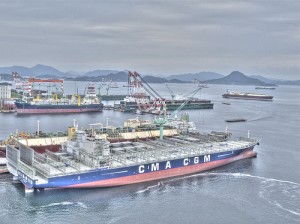
Samsung Heavy Industries HDR Arial View
Samsung Heavy Industries Co., South Korea’s third-largest shipbuilder, said Sunday it has developed an anti-piracy solution system that can track down and repel nearby pirate ships.


The development of an anti-piracy system comes amid rising alarm that overseas pirates are targeting South Korean ships. On Friday, South Korean naval special forces successfully rescued 21 seamen and their 11,500-ton cargo ship, the Samho Jewelry, that was hijacked by Somali pirates.


Two months earlier, a South Korean supertanker was also released after being held captive by Somali pirates for seven months, in exchange for a reported ransom of around $9 million.

According to Samsung Heavy, the new system tracks down suspected pirate ships within 10 kilometers by analyzing their speed and direction. The anti-piracy solution also features a surveillance system that records real-time videos of suspected ships and water cannons with a maximum range of 70 meters, the shipbuilder said.

Monday, January 24, 2011

South Korean shipbuilder rolls out anti-piracy system


South Korean shipbuilder rolls out anti-piracy system
South Korea's Samsung Heavy Industries has rolled out a system to help ships detect and fend off pirates, after the recent hijacking of a South Korean freighter near Somalia alarmed shippers.
The nation's third-largest shipbuilder on Sunday said the new anti-piracy system detects smaller boats in the vicinity often undetected under existing marine radar systems and issues an automatic alert when approached.
"The alert is issued when an approaching vessel does not respond to usual ship-to-ship radio communications or shows unusual navigating patterns and speed," the company spokesman told AFP.
The system allows sailors in a navigation room to remotely control water cannons on the ship's deck that can up to 70 metres (230 feet) when pirates attempt to climb aboard.
"That way, crew will be safe from potential shooting attacks from pirates when firing the water cannons," said the spokesman, adding the system is applicable to most existing ships.

Thursday, January 20, 2011

Korean Researchers Reveal New Sea Defense Model


Korean Researchers Reveal New Sea Defense Model
Military tension between North Korea and the Republic of Korea (South Korea) extends to areas of the Yellow Sea. Now defence experts based in the Republic of Korea have devised improved methods to model underwater warfare, which they believe can aid future decisions about weapons and defence purchases. The details appear in the Journal of Defense Modeling and Simulation, published by SAGE.

The researchers based at the Korea Advanced Institute of Science and Technology (KAIST) and Seowon University, both in the Republic of Korea, set out to design an underwater warfare model to gain insight into how factors such as tactics and the performance of underwater weapons influence the measurement of effectiveness (MOE) of a weapons system.
Governments considering whether to purchase equipment, such as torpedoes or mobile decoys, use these types of modelling and simulation as part of their decision making process both for purchases, and for making tactical decisions.

Tuesday, January 4, 2011

South Korea deploys more anti-submarine aircraft on sea border

SEOUL (AFP): South Korea has deployed five extra anti-submarine patrol aircraft to guard against a potential attack by North Korea, a report said Tuesday, amid high tension on the disputed sea border.


The military on Saturday deployed five P-3CK surveillance aircraft in addition to 11 anti-submarine planes already in operation to patrol the sea off the west and east coasts, JoongAng Ilbo newspaper reported.

The move is “aimed to improve the ability to detect submarines following a North Korean submarine's attack on the Cheonan warship,” the paper quoted a military official as saying.

Seoul, citing a multinational investigation, blamed Pyongyang for torpedoing its Cheonan warship in March 2010, killing 46 sailors, a charge the North has vehemently denied.

Related Posts Plugin for WordPress, Blogger...